
- 联系我们
- duidaima.com 版权声明
- 闽ICP备2020021581号
-
 闽公网安备 35020302035485号
闽公网安备 35020302035485号

3.分段锁
// 获取自旋锁
func (sl *spinLock) lock() {
 for !atomic.CompareAndSwapUint32((*uint32)(sl), 0, 1) {
  // 获取到自旋锁
 }
}
上面的代码直观上很符合自旋锁的语义,只要没有获取到锁,就一直空转 CPU 尝试获取锁,但是这会带来一个问题: CPU 空转带来了很大的资源浪费, 是否可以降低甚至避免这种资源浪费吗?2.引起上下文切换,因为当前 goroutine 休眠,根据 GMP 调取器的管理规则,处理器 P 会切换到其他可以运行的 goroutine, 如果当前 P 的 goroutine 队列已经是空的, 那么会给当前 M 关联一个新的处理器,不管是哪种情况发生,都会引起上下文切换
// 堆代码 duidaima.com
const maxBackoff = 16
func (sl *spinLock) Lock() {
 backoff := 1
 for !atomic.CompareAndSwapUint32((*uint32)(sl), 0, 1) {
  for i := 0; i < backoff; i++ {
   runtime.Gosched()
  }

  if backoff < maxBackoff {
   backoff <<= 1
  }
 }
}
作者借鉴了 TCP 流量控制中的指数退避理念,每两次获取锁的间隔时间呈指数级别增长,并且在间隔时间内执行 N 次 GMP 调取,当然这是根据该组件的场景特性决定的 (goroutine pool), 在实际项目中实现和使用自旋锁时,也可以根据具体的业务场景来自定义间隔时间内的操作,比如可以执行一个 CPU 密集型的任务,最终的目的只有一个: 尽可能榨干 CPU 资源。// 普通自旋锁实现 --------------------------------------------
type originSpinLock uint32
func (sl *originSpinLock) Lock() {
for !atomic.CompareAndSwapUint32((*uint32)(sl), 0, 1) {
runtime.Gosched()
}
}
func (sl *originSpinLock) Unlock() {
atomic.StoreUint32((*uint32)(sl), 0)
}
func NewOriginSpinLock() sync.Locker {
return new(originSpinLock)
}
// 优化自旋锁实现 --------------------------------------------
type spinLock uint32
const maxBackoff = 16
func (sl *spinLock) Lock() {
backoff := 1
for !atomic.CompareAndSwapUint32((*uint32)(sl), 0, 1) {
for i := 0; i < backoff; i++ {
runtime.Gosched()
}
if backoff < maxBackoff {
backoff <<= 1
}
}
}
func (sl *spinLock) Unlock() {
atomic.StoreUint32((*uint32)(sl), 0)
}
func NewSpinLock() sync.Locker {
return new(spinLock)
}
// 标准库的互斥锁
func BenchmarkMutex(b *testing.B) {
m := sync.Mutex{}
b.RunParallel(func(pb *testing.PB) {
for pb.Next() {
m.Lock()
m.Unlock()
}
})
}
// 普通自旋锁
func BenchmarkSpinLock(b *testing.B) {
spin := NewOriginSpinLock()
b.RunParallel(func(pb *testing.PB) {
for pb.Next() {
spin.Lock()
spin.Unlock()
}
})
}
// 优化版自旋锁
func BenchmarkBackOffSpinLock(b *testing.B) {
spin := NewSpinLock()
b.RunParallel(func(pb *testing.PB) {
for pb.Next() {
spin.Lock()
spin.Unlock()
}
})
}
从测试结果可以看到,优化后的自旋锁相比普通自旋锁和互斥锁,性能有了很大的提高。// goos: linux // goarch: amd64 // cpu: Intel(R) Core(TM) i5-8300H CPU @ 2.30GHz // BenchmarkMutex // BenchmarkMutex-8 21886387 55.83 ns/op // BenchmarkSpinLock // BenchmarkSpinLock-8 46848830 25.81 ns/op // BenchmarkBackOffSpinLock // BenchmarkBackOffSpinLock-8 55894545 21.16 ns/op
type ConcurrentMap[K comparable, V any] struct {
 shards   []*ConcurrentMapShared[K, V]
 sharding func(key K) uint32
}
GetShard 方法用于计算给定的参数 key 对应的区间元素集合对象并返回。func (m ConcurrentMap[K, V]) GetShard(key K) *ConcurrentMapShared[K, V] {
// 优化版: m % n = m & ( n - 1 )
return m.shards[uint(m.sharding(key))%uint(SHARD_COUNT)]
}
type ConcurrentMapShared[K comparable, V any] struct {
 items        map[K]V
 sync.RWMutex
}
操作原语func (m ConcurrentMap[K, V]) Set(key K, value V) {
shard := m.GetShard(key)
shard.Lock()
shard.items[key] = value
shard.Unlock()
}
2. GETfunc (m ConcurrentMap[K, V]) Get(key K) (V, bool) {
shard := m.GetShard(key)
shard.RLock()
val, ok := shard.items[key]
shard.RUnlock()
return val, ok
}
3. Hasfunc (m ConcurrentMap[K, V]) Has(key K) bool {
shard := m.GetShard(key)
shard.RLock()
_, ok := shard.items[key]
shard.RUnlock()
return ok
}
4. Removefunc (m ConcurrentMap[K, V]) Remove(key K) {
shard := m.GetShard(key)
shard.Lock()
delete(shard.items, key)
shard.Unlock()
}
哈希算法func strfnv32[K fmt.Stringer](key K "K fmt.Stringer") uint32 {
return fnv32(key.String())
}
func fnv32(key string) uint32 {
...
}
除此之外,也可以通过 NewWithCustomShardingFunction 函数在创建 Map 时来指定哈希函数:func NewWithCustomShardingFunction[K comparable, V any](sharding func(key K "K comparable, V any") uint32) ConcurrentMap[K, V] {
return create[K, V](sharding "K, V")
}
基准测试package maps
import (
"strconv"
"sync"
"testing"
cmap "github.com/orcaman/concurrent-map/v2"
)
// 线程安全 Map 接口
type ThreadSafeMap interface {
Get(key string) any
Set(key string, val any)
}
// -------------------------------------------------------------------
// map 数据类型 + 读写锁实现线程安全的 map
type MutexMap struct {
sync.RWMutex
m map[string]any
}
func (m *MutexMap) Get(key string) any {
m.RLock()
v, ok := m.m[key]
m.RUnlock()
if ok {
return v
}
return nil
}
func (m *MutexMap) Set(key string, val any) {
m.Lock()
m.m[key] = val
m.Unlock()
}
// -------------------------------------------------------------------
// sync.Map 实现线程安全的 map
type SyncMap struct {
m sync.Map
}
func (s *SyncMap) Get(key string) any {
v, _ := s.m.Load(key)
return v
}
func (s *SyncMap) Set(key string, val any) {
s.m.Store(key, val)
}
// -------------------------------------------------------------------
// 分段锁实现线程安全的 map
type ConcurMap struct {
m cmap.ConcurrentMap[string, any]
}
func (c *ConcurMap) Get(key string) any {
v, _ := c.m.Get(key)
return v
}
func (c *ConcurMap) Set(key string, val any) {
c.m.Set(key, val)
}
// 基准测试
func benchmark(b *testing.B, m ThreadSafeMap, read, write int) {
for i := 0; i < b.N; i++ {
var wg sync.WaitGroup
// 注意: 这里的读写操作有一部分 key 是重合的
// 读操作
for k := 0; k < read*100; k++ {
wg.Add(1)
go func(key int) {
m.Get(strconv.Itoa(i * key))
wg.Done()
}(k)
}
// 写操作
for k := 0; k < write*100; k++ {
wg.Add(1)
go func(key int) {
m.Set(strconv.Itoa(i*key), key)
wg.Done()
}(k)
}
wg.Wait()
}
}
// 读写比例 9:1
func BenchmarkReadMoreRWMutex(b *testing.B) { benchmark(b, &MutexMap{m: make(map[string]any)}, 9, 1) }
func BenchmarkReadMoreSyncMap(b *testing.B) { benchmark(b, &SyncMap{m: sync.Map{}}, 9, 1) }
func BenchmarkReadMoreConcurMap(b *testing.B) { benchmark(b, &ConcurMap{m: cmap.New[any]( "any")}, 9, 1) }
// 读写比例 1:9
func BenchmarkWriteMoreRWMutex(b *testing.B) { benchmark(b, &MutexMap{m: make(map[string]any)}, 1, 9) }
func BenchmarkWriteMoreSyncMap(b *testing.B) { benchmark(b, &SyncMap{m: sync.Map{}}, 1, 9) }
func BenchmarkWriteMoreConcurMap(b *testing.B) { benchmark(b, &ConcurMap{m: cmap.New[any]( "any")}, 1, 9) }
// 读写比例 5:5
func BenchmarkEqualRWMutex(b *testing.B) { benchmark(b, &MutexMap{m: make(map[string]any)}, 5, 5) }
func BenchmarkEqualSyncMap(b *testing.B) { benchmark(b, &SyncMap{m: sync.Map{}}, 5, 5) }
func BenchmarkEqualConcurMap(b *testing.B) { benchmark(b, &ConcurMap{m: cmap.New[any]( "any")}, 5, 5) }
运行基准测试:$ go test -count=1 -run='^$' -bench=. -benchtime=3s -benchmem输出结果如下:
goos: linux
goarch: amd64
cpu: Intel(R) Core(TM) i5-8300H CPU @ 2.30GHz
BenchmarkReadMoreRWMutex-8                  9107            362827 ns/op           84094 B/op       3001 allocs/op
BenchmarkReadMoreSyncMap-8                  7740            765258 ns/op          128974 B/op       3284 allocs/op
BenchmarkReadMoreConcurMap-8               10000            345271 ns/op           83985 B/op       3000 allocs/op
BenchmarkWriteMoreRWMutex-8                 6212            825778 ns/op          137330 B/op       3656 allocs/op
BenchmarkWriteMoreSyncMap-8                 3352           1155236 ns/op          157766 B/op       6041 allocs/op
BenchmarkWriteMoreConcurMap-8               9480            370214 ns/op          119970 B/op       3653 allocs/op
BenchmarkEqualRWMutex-8                     7108            529450 ns/op          104626 B/op       3249 allocs/op
BenchmarkEqualSyncMap-8                     5360            735393 ns/op          133008 B/op       4601 allocs/op
BenchmarkEqualConcurMap-8                   9548            347809 ns/op          104303 B/op       3250 allocs/op
PASS
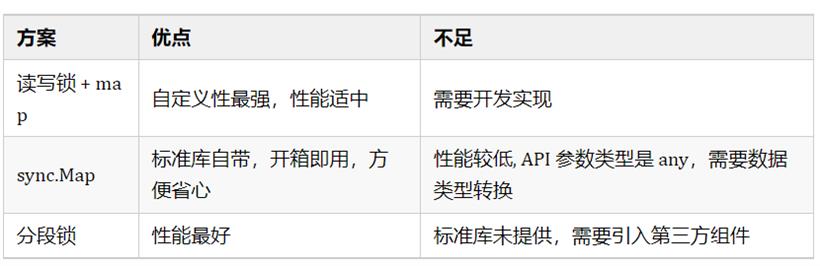
从基准测试的输出结果来看,不论是哪种应用场景,结合运行速度还是内存分配,三者的排序都是一致的: 分段锁优于读写锁 + map, 后者优于 sync.Map 。 笔者没有遇到过 100% 的只读或只写操作的应用场景,所以没有做对应的基准测试,不过这里可以猜测一下:
本文主要介绍了在 Go 语言中如何实现线程安全的 map 的三种方法,并通过三种常见的业务场景对方法进行了性能基准测试,最后,我们来简单总结下三种方法的特点。