

- 联系我们
- duidaima.com 版权声明
- 闽ICP备2020021581号
-
 闽公网安备 35020302035485号
闽公网安备 35020302035485号

3.实际使用场景是多样化的,如何选择合适的淘汰策略?
# 客户端命令方式配置和查看内存大小
127.0.0.1:6379> config get maxmemory
"maxmemory"
"0"
127.0.0.1:6379> config set maxmemory 100mb
OK
127.0.0.1:6379> config get maxmemory
"maxmemory"
"104857600"

#通过redis.conf 配置文件配置
127.0.0.1:6379> info
# Server
#...
# 配置文件路径
config_file:/opt/homebrew/etc/redis.conf
#...
# 堆代码 duidaima.com

# 修改内存大小
> vim /opt/homebrew/etc/redis.conf
############################## MEMORY MANAGEMENT ################################

# Set a memory usage limit to the specified amount of bytes.
# When the memory limit is reached Redis will try to remove keys
# according to the eviction policy selected (see maxmemory-policy).
#
#...
maxmemory 100mb
#...
注:若`maxmemory=0`则表示不做内存限制,但是对于windows系统来说,32位系统默认可使用空间是3G,因为整个系统内存是4G,需要留1G给系统运行。且淘汰策略会自动设置为noeviction,即不开启淘汰策略,当使用空间达到3G的时候,新的内存请求会报错。
# 命令行配置方式
127.0.0.1:6379> CONFIG GET maxmemory-policy
"maxmemory-policy"
"noeviction"
127.0.0.1:6379> CONFIG SET maxmemory-policy volatile-lru
OK
127.0.0.1:6379> CONFIG GET maxmemory-policy
"maxmemory-policy"
"volatile-lru"

#redis.conf文件配置方式
# MAXMEMORY POLICY: how Redis will select what to remove when maxmemory
# is reached. You can select one from the following behaviors:
#
# volatile-lru -> Evict using approximated LRU, only keys with an expire set.
# allkeys-lru -> Evict any key using approximated LRU.
# volatile-lfu -> Evict using approximated LFU, only keys with an expire set.
# allkeys-lfu -> Evict any key using approximated LFU.
# volatile-random -> Remove a random key having an expire set.
# allkeys-random -> Remove a random key, any key.
# volatile-ttl -> Remove the key with the nearest expire time (minor TTL)
# noeviction -> Don't evict anything, just return an error on write operations.
#
# LRU means Least Recently Used
# LFU means Least Frequently Used
#
# Both LRU, LFU and volatile-ttl are implemented using approximated
# randomized algorithms.
# The default is:
# ...
maxmemory-policy noeviction
freeMemoryIfNeeded逻辑处理
int freeMemoryIfNeeded(void) {
  size_t mem_used, mem_tofree, mem_freed;
  int slaves = listLength(server.slaves);

  /* Remove the size of slaves output buffers and AOF buffer from the count of used memory.*/
  // 计算出 Redis 目前占用的内存总数,但有两个方面的内存不会计算在内:
  // 1)从服务器的输出缓冲区的内存
  // 2)AOF 缓冲区的内存
  mem_used = zmalloc_used_memory();
  if (slaves) {
    listIter li;
    listNode *ln;

    listRewind(server.slaves,&li);
    while((ln = listNext(&li))) {
      redisClient *slave = listNodeValue(ln);
      unsigned long obuf_bytes = getClientOutputBufferMemoryUsage(slave);
      if (obuf_bytes > mem_used)
        mem_used = 0;
      else
        mem_used -= obuf_bytes;
    }
  }
  if (server.aof_state != REDIS_AOF_OFF) {
    mem_used -= sdslen(server.aof_buf);
    mem_used -= aofRewriteBufferSize();
  }

  /* Check if we are over the memory limit. */
  // 如果目前使用的内存大小比设置的 maxmemory 要小,那么无须执行进一步操作
  if (mem_used <= server.maxmemory) return REDIS_OK;

  // 如果占用内存比 maxmemory 要大,但是 maxmemory 策略为不淘汰,那么直接返回
  if (server.maxmemory_policy == REDIS_MAXMEMORY_NO_EVICTION)
    return REDIS_ERR; /* We need to free memory, but policy forbids. */

  /* Compute how much memory we need to free. */
  // 计算需要释放多少字节的内存
  mem_tofree = mem_used - server.maxmemory;

  // 初始化已释放内存的字节数为 0
  mem_freed = 0;

  // 根据 maxmemory 策略,
  // 遍历字典,释放内存并记录被释放内存的字节数
  while (mem_freed < mem_tofree) {
    int j, k, keys_freed = 0;

    // 遍历所有字典
    for (j = 0; j < server.dbnum; j++) {
      long bestval = 0; /* just to prevent warning */
      sds bestkey = NULL;
      dictEntry *de;
      redisDb *db = server.db+j;
      dict *dict;

      if (server.maxmemory_policy == REDIS_MAXMEMORY_ALLKEYS_LRU ||
        server.maxmemory_policy == REDIS_MAXMEMORY_ALLKEYS_RANDOM)
      {
        // 如果策略是 allkeys-lru 或者 allkeys-random
        // 那么淘汰的目标为所有数据库键
        dict = server.db[j].dict;
      } else {
        // 如果策略是 volatile-lru 、 volatile-random 或者 volatile-ttl
        // 那么淘汰的目标为带过期时间的数据库键
        dict = server.db[j].expires;
      }

      // 跳过空字典
      if (dictSize(dict) == 0) continue;

      /* volatile-random and allkeys-random policy */
      // 如果使用的是随机策略,那么从目标字典中随机选出键
      if (server.maxmemory_policy == REDIS_MAXMEMORY_ALLKEYS_RANDOM ||
        server.maxmemory_policy == REDIS_MAXMEMORY_VOLATILE_RANDOM)
      {
        de = dictGetRandomKey(dict);
        bestkey = dictGetKey(de);
      }

      /* volatile-lru and allkeys-lru policy */
      // 如果使用的是 LRU 策略,
      // 那么从一集 sample 键中选出 IDLE 时间最长的那个键
      else if (server.maxmemory_policy == REDIS_MAXMEMORY_ALLKEYS_LRU ||
        server.maxmemory_policy == REDIS_MAXMEMORY_VOLATILE_LRU)
      {
        struct evictionPoolEntry *pool = db->eviction_pool;

        while(bestkey == NULL) {
          evictionPoolPopulate(dict, db->dict, db->eviction_pool);
          /* Go backward from best to worst element to evict. */
          for (k = REDIS_EVICTION_POOL_SIZE-1; k >= 0; k--) {
            if (pool[k].key == NULL) continue;
            de = dictFind(dict,pool[k].key);

            /* Remove the entry from the pool. */
            sdsfree(pool[k].key);
            /* Shift all elements on its right to left. */
            memmove(pool+k,pool+k+1,
              sizeof(pool[0])*(REDIS_EVICTION_POOL_SIZE-k-1));
            /* Clear the element on the right which is empty since we shifted one position to the left.  */
            pool[REDIS_EVICTION_POOL_SIZE-1].key = NULL;
            pool[REDIS_EVICTION_POOL_SIZE-1].idle = 0;

            /* If the key exists, is our pick. Otherwise it is a ghost and we need to try the next element. */
            if (de) {
              bestkey = dictGetKey(de);
              break;
            } else {
              /* Ghost... */
              continue;
            }
          }
        }
      }

      /* volatile-ttl */
      // 策略为 volatile-ttl ,从一集 sample 键中选出过期时间距离当前时间最接近的键
      else if (server.maxmemory_policy == REDIS_MAXMEMORY_VOLATILE_TTL) {
        for (k = 0; k < server.maxmemory_samples; k++) {
          sds thiskey;
          long thisval;

          de = dictGetRandomKey(dict);
          thiskey = dictGetKey(de);
          thisval = (long) dictGetVal(de);

          /* Expire sooner (minor expire unix timestamp) is better candidate for deletion */
          if (bestkey == NULL || thisval < bestval) {
            bestkey = thiskey;
            bestval = thisval;
          }
        }
      }

      /* Finally remove the selected key. */
      // 删除被选中的键
      if (bestkey) {
        long long delta;

        robj *keyobj = createStringObject(bestkey,sdslen(bestkey));
        propagateExpire(db,keyobj);
        // 计算删除键所释放的内存数量
        delta = (long long) zmalloc_used_memory();
        dbDelete(db,keyobj);
        delta -= (long long) zmalloc_used_memory();
        mem_freed += delta;

        // 对淘汰键的计数器增一
        server.stat_evictedkeys++;

        notifyKeyspaceEvent(REDIS_NOTIFY_EVICTED, "evicted",
            keyobj, db->id);
        decrRefCount(keyobj);
        keys_freed++;

        /* When the memory to free starts to be big enough, we may */
        /* start spending so much time here that is impossible to */
        /* deliver data to the slaves fast enough, so we force the */
        /* transmission here inside the loop. */
        if (slaves) flushSlavesOutputBuffers();
      }
    }

    if (!keys_freed) return REDIS_ERR; /* nothing to free... */
  }

  return REDIS_OK;
}
 /* Redis maxmemory strategies */
 #define REDIS_MAXMEMORY_VOLATILE_LRU 0
 #define REDIS_MAXMEMORY_VOLATILE_TTL 1
 #define REDIS_MAXMEMORY_VOLATILE_RANDOM 2
 #define REDIS_MAXMEMORY_ALLKEYS_LRU 3
 #define REDIS_MAXMEMORY_ALLKEYS_RANDOM 4
 #define REDIS_MAXMEMORY_NO_EVICTION 5
 #define REDIS_DEFAULT_MAXMEMORY_POLICY REDIS_MAXMEMORY_NO_EVICTION
noeviction( REDIS_MAXMEMORY_NO_EVICTION): Don't evict anything, just return an error on write operations -> 不开启淘汰策略,在不配置淘汰策略的情况下,maxmemory-policy默认等于该值。内存不足时,会抛出异常,写操作不可用。不同系统存在差异性-具体见⇑
# The counter decay time is the time, in minutes, that must elapse in order
# for the key counter to be divided by two (or decremented if it has a value
# less <= 10).
#
# The default value for the lfu-decay-time is 1. A special value of 0 means to
# decay the counter every time it happens to be scanned.
#
lfu-decay-time 1
若整体访问频率较为平衡,则可选择allkeys-random策略随机淘汰数据。
3.内存空间是有限的,除了过期策略,Redis还有什么其他保障?
# expire: t秒后过期
expire key seconds
# pexpire: t毫秒后过期
pexpire key millseconds
# expireat: 到达具体的时间戳时过期,精确到秒
expireat key timestamp
# pexpireat: 到达具体的时间戳时过期,精确到毫秒
pexpire key millseconds
这四个命令看似有差异,但在RedisDb底层,最终都会转换成pexpireat指令。内部由db.c/expireGenericCommand函数实现,对外由上面四个指令调用
//expire命令
void expireCommand(redisClient *c) {
  expireGenericCommand(c,mstime(),UNIT_SECONDS);
}
//expireat命令
void expireatCommand(redisClient *c) {
  expireGenericCommand(c,0,UNIT_SECONDS);
}
//pexpire命令
void pexpireCommand(redisClient *c) {
  expireGenericCommand(c,mstime(),UNIT_MILLISECONDS);
}
//pexpireat命令
void pexpireatCommand(redisClient *c) {
  expireGenericCommand(c,0,UNIT_MILLISECONDS);
}

/* This is the generic command implementation for EXPIRE, PEXPIRE, EXPIREAT
* and PEXPIREAT. Because the commad second argument may be relative or absolute
* the "basetime" argument is used to signal what the base time is (either 0
* for *AT variants of the command, or the current time for relative expires).
*/
void expireGenericCommand(redisClient *c, long long basetime, int unit) {
  ...
  /* unix time in milliseconds when the key will expire. */
  long long when;
  ...
  //如果是秒转换为毫秒
  if (unit == UNIT_SECONDS) when *= 1000;
  when += basetime;
  ...
}
过期字典内部存储结构:key表示一个指向具体键的指针,value是long类型的毫秒精度的UNIX时间戳。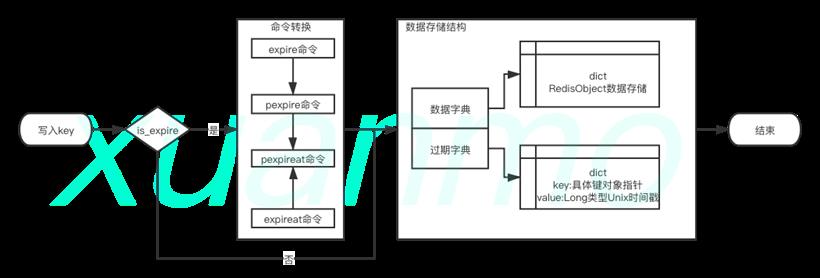
3.惰性删除:数据不做及时释放,待下一次接收到读写请求时,先进行过期检查,若已过期则直接删除。用内存存储空间换取CPU性能——即用空间换取时间。
| 删除方式 | 优点 | 缺点 |
|---|---|---|
| 定时删除 | 能及时释放内存空间,不会产生滞留数据 | 频繁生成和销毁定时器,非常损耗CPU性能,影响响应时间和指令吞吐量 |
| 定期删除 | 固定的频率进行过期检查,对CPU交友好 | 1.数据量比较大的情况下,会因为全局扫描而损耗CPU性能,且主线程的阻塞会导致其他请求响应延迟。2.未能及时释放内存空间。3.数据已过期,但定时器未执行时会导致数据不一致。 |
| 惰性删除 | 节约CPU性能 | 当某些数据长时间无请求访问时,会导致数据滞留,使内存无法释放,占用内存空间,甚至坑导致内存泄漏而引发服务不可用 |
# The range is between 1 and 500, however a value over 100 is usually not
# a good idea. Most users should use the default of 10 and raise this up to
# 100 only in environments where very low latency is required.
hz 10
| 删除方式 | 优点 | 缺点 |
|---|---|---|
| Redis定期删除 | 避免了全局扫描,每次随机抽取数据量较少,性能较稳定,执行频率可配置;避免了惰性删除低频数据长时间滞留的问题 | 存在概率上某些数据一直没被抽取的情况,导致数据滞留 |
| Redis惰性删除 | 解决了定期删除可能导致的数据滞留现象,性能较高 | 低频数据长时间无法释放 |
2.3 过期时间命令EX|PX,在主从同步时,因为同步需要时间,就会导致主从库实际过期时间出现偏差。比如主库设置过期时间60s,但同步全量花费了1分钟,那么在从库接收到命令并执行之后,就导致从库key的过期时间整体跨越了两分钟,而此时主库在一分钟之前数据就已经过期了。EXAT|PXAT 命令来设置过期时间节点。这样可避免增量同步的发生。但需注意主从服务器时间一致。